
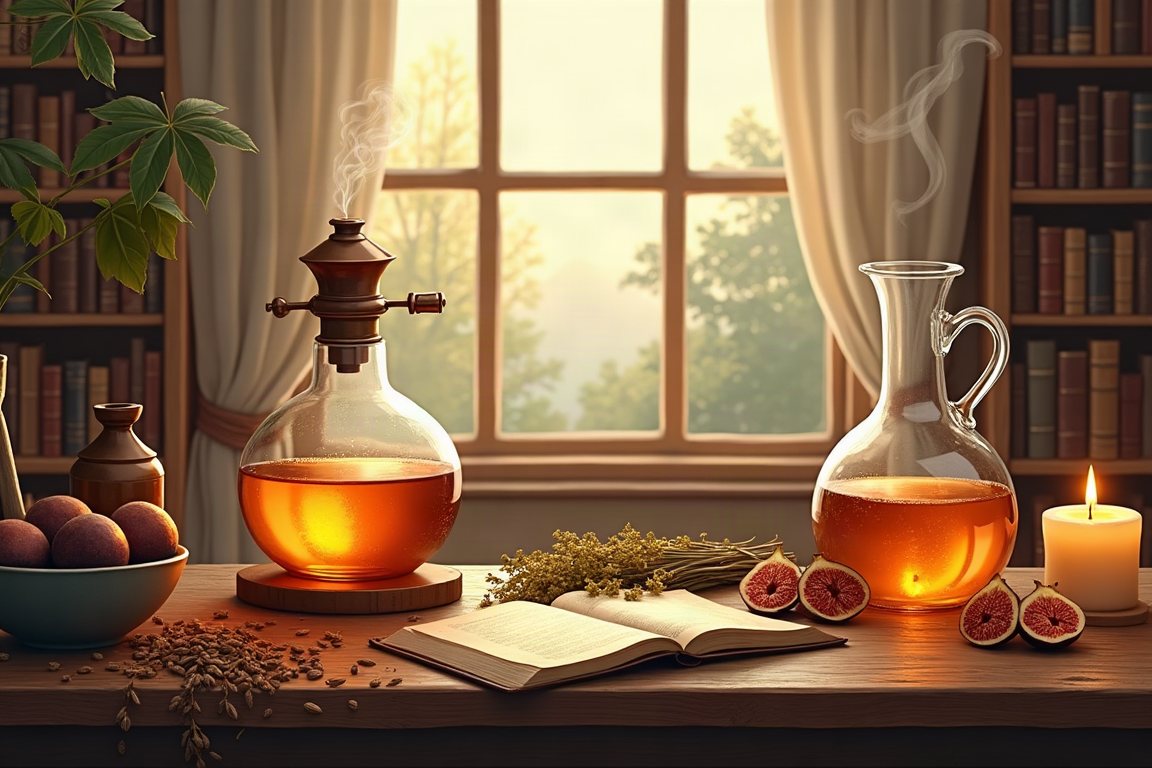
Picture the alchemist as popular art draws him: a wild beard, a furnace, an alembic dripping something that will — any day now — turn lead into gold. Now picture instead a walled garden in the country outside a sixteenth-century town: raised beds in strict order, a still-house at the gate, dew gathered at dawn in white linen, herbs cut by the moon's phase and dried on the north side of the wall. The second picture is at least as true to the tradition, and it is the key to the first. Alchemy was never only a chemistry that failed. It was a philosophy of transformation that took the garden as its textbook, and this essay reads it that way: the stages of the Work as a year in the garden, the gardener as the first alchemist, and the true gold as the ripened thing — plant, soul, or both — that comes from patient succession.
The garden as the first laboratory
Every metaphor of the alchemical literature is agricultural before it is metallic. The Philosopher's Stone is sown like seed; the Secret Fire ripens matter "as the sun ripens grain"; the adepts' matter must be spring, summer, autumn, and winter in turn. This was not decoration. The alchemists inherited, from Greek natural philosophy and from the craft-guilds of dyers, smiths, and herbalists, a single governing idea: nature does not leap. Something lower becomes something higher through succession — gestation, death, putrefaction, rebirth — and the artist's role is to assist nature, not to bypass it. The Latin tag repeated across the medieval literature says the Work must be done as nature does her work. A garden is the most legible demonstration of that law a human being can watch: no seed skips the dark.
The year of the Work
The alchemists enumerated the stages of transformation with varying labels; the classical list runs calcination, dissolution, separation, conjunction, fermentation, distillation, coagulation. Set the list against a garden year and it reads like a diary:
Calcination is the burning-off of autumn — the old stalks on the fire, the bed reduced to ash that will feed it. Dissolution is the winter rain, softening everything fixed. Separation is the spring cleaning: stones from soil, weed from herb, the gardener's discerning hand. Conjunction is planting — seed and soil married in the dark, the operation every tradition calls the central mystery because nothing here can be forced or fully explained. Fermentation is the silent rise of the sown — the sap climbing, the first rot-sweet smell of the warming heap. Distillation is the essence rising: the herb's volatile soul carried up and gathered cool at dawn. Coagulation is the harvest: the volatile made fixed again, the essential stored in jars against winter — matter holding its spirit permanently, which is, says the tradition, exactly what the Stone is.
What the gardener does to the seed, the alchemist attempted upon the soul: not to abolish matter, but to bring it to ripeness.
The planetary beds
The herbals of the alchemical age organized the garden by the seven classical planets, on the logic that like ripens like: the sun-faced marigold and St. John's wort under the Sun, silver-leafed plants under the Moon, the blue-throated monkshood under grim Saturn, the venusian roses and cherries under Venus. Paracelsus, the sixteenth-century physician-hermeticist who did more than anyone to fuse alchemy with medicine, taught that each plant carries the signature of its ruling body — that the appearance of a thing announces its use. His followers, the spagyrists, distilled and calcined herbs into refined preparations, and the word itself — from the Greek for to pull apart and to join together — is the whole doctrine in two roots: separate, then recombine what was separated, now purified.
A word of honesty belongs here. Signature-lore is a historical and symbolic system, not validated pharmacology, and the preparations of the old spagyric workshops are of interest to this library as history and as practice of attention — not as medicine. Nothing in our garden essay is advice about treating any condition; for that, consult a qualified professional. What the planetary garden offers a modern reader is a way of seeing: an arrangement of the plant world that makes the year legible as a story.
The enclosed garden of the soul
There is a reason the mystics of three faiths reached for garden imagery when they spoke of the inner life. The walled garden — the hortus conclusus of the Song of Songs, the paridaeza of Persian kings, the courtyard gardens of the Alhambra — is a place made by separation: wall from wilderness, tending from neglect. The alchemical writers were explicit that the first vessel of the Work is not glass but attention. The matter must be sealed — that is the meaning of the Hermetic seal, from a Greek epithet for Thoth-Hermes — sealed against distraction, doubt, and the curious neighbor's opinion, while nature does her slow work inside.
Read as instruction rather than laboratory protocol, this is a complete contemplative method. Choose one transformation. Wall it — a journal, an hour, a vow of silence about it while it is young. Burn what is dead in it; water what is alive; separate what does not belong; wait through the necessary darkness without digging up the seed to check on it. The alchemists called the waiting matter the black sun, and they called what comes after it white, then red. Gardeners simply call it spring.
Taking the long way round
The tragedy of alchemy, its historians now generally say, is not that it failed to make gold but that its finest insights were locked in a language of deliberate obscurity. Its triumph is that the obscurity never fully succeeded: the imagery escaped — into poetry, into depth psychology, into every story we tell about patience rewarded and darkness necessary. The garden remains its plainest, freest translation. To grow anything — basil on a windowsill, a friendship, a craft, a self — is to practice the royal art in its oldest form. The gold was always the ripening.
Our Mysticism shelf gathers the alchemical and hermetic tradition in readable modern editions — the pictures, the stages, and the gardens between them. For the manuscripts themselves, see Alchemical Manuscripts, Box 40 — 243 of them, gathered by Manly P. Hall.
Further reading
The single best companion to the imagery here is Arthur Edward Waite's 1893 Hermetic Museum, which collects the classic German alchemical treatises in English; the Internet Archive holds the first volume complete. The alchemy section of Sacred Texts gathers many primary texts in plain form; and Paracelsus's restless life is well summarized in his encyclopedia entry.