A temple at the edge of the morning
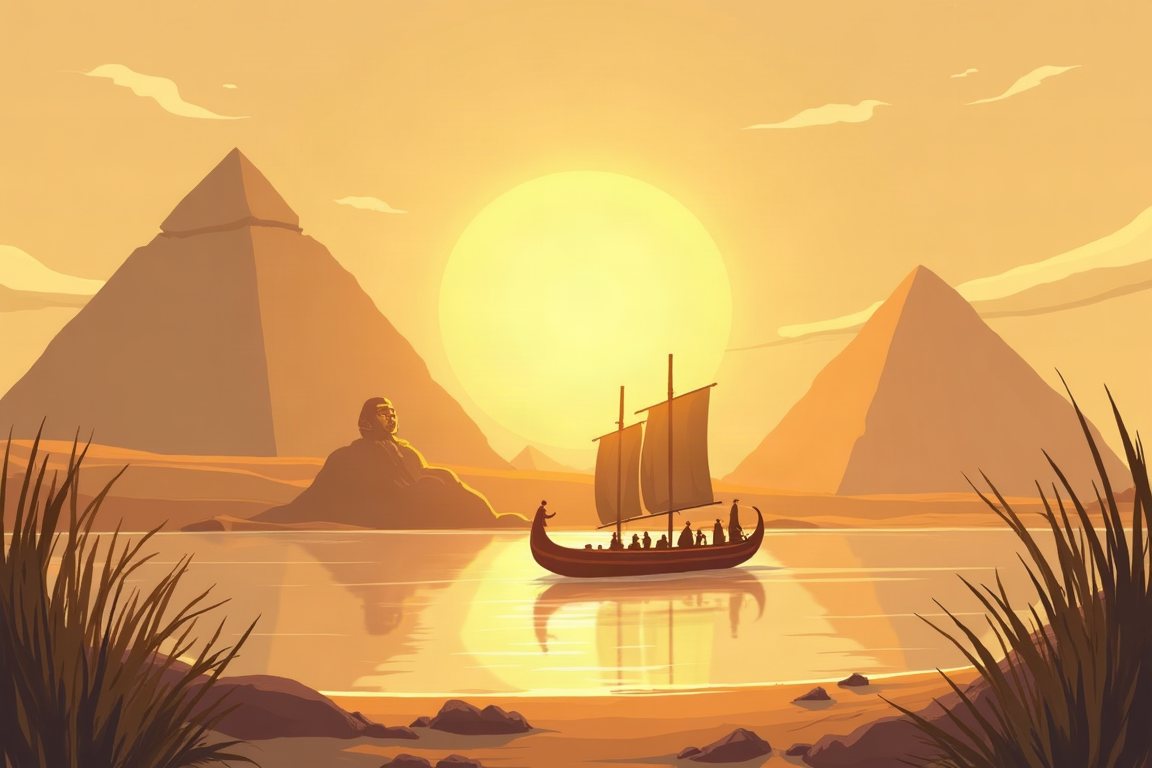
Long before Cairo, before Alexandria, before the pyramids wore their smooth white casing, there was a city the Egyptians called Iunu — the Greeks would say Heliopolis, the City of the Sun. Almost nothing of it remains above the ground today; its stones were quarried for later cities, its obelisks carried off to Rome, Istanbul, and New York. Yet of all the sacred precincts of Egypt, this is the one whose ideas most shaped what came after. If you have ever read a creation story, said a prayer to a creator, or drawn a picture of the sun as a living thing, you have touched, however distantly, the theology of Iunu.
This essay is a reading of that theology — not as museum trivia, but as a working map of reality that a civilization kept and polished for three thousand years. And because our own library shelves a modern reading of the same tradition, we will close with how a seeker today might use it.
The story the priests told
In the beginning, the priests of Heliopolis taught, there was only Nun — the dark, endless, inert waters. Not a god exactly, more a condition: pure potential, unformed and aware of nothing. Then, from those waters, a mound rose. This was not an accident of geology. Every year the Nile flooded and withdrew, and the first black earth to appear above the water was the holiest thing the Egyptians knew: dry land, order, the possibility of planting and building. Their creation myth simply said the universe began the way their year began. The first dry hill — the benben — became the pedestal on which the first god stood.
That god was Atum, whose name means something like "the complete one" or "the all." Atum was not a craftsman shaping the world from outside. The Heliopolitan teaching is stranger and more intimate: Atum brought the rest of reality out of himself, alone, by an act that the texts describe first as exhalation and later, more graphically, as self-generation. From Atum came Shu, the dry air and space between things, and Tefnut, moisture and ordering warmth. Shu and Tefnut in turn produced Geb, the earth, and Nut, the sky — the land we walk and the arched blue dome over it, and in Egyptian art they are forever separated by the arms of Shu holding them apart, which is simply what air does: it holds earth and sky at a living distance.
Geb and Nut had four children, and with them the family — the Ennead, the company of Nine — was complete: Osiris, Isis, Set, and Nephthys. Count Atum and you have nine names. Nine principles. Nine ways the one completeness unfolds into a world.
Nine is not a number here; it is a sentence
It is tempting to read this as a fairy tale about characters, and Egyptian art encourages the temptation: gods with falcon heads, a goddess with a throne on her crown. But the priests were doing something more like philosophy in narrative dress. Each name in the Ennead names a condition without which no world could appear:
Atum — totality, the undivided source. Shu — space, the gap that lets two things differ. Tefnut — the ordering principle, later wisdom-teachers would say logos or dharma. Geb — matter, stability, ground. Nut — the overarching whole, the pattern that includes everything. Osiris — renewal, the green force that dies into seed and returns as harvest. Isis — attentive love, the power that gathers and restores what has been scattered. Set — violence, differentiation, the storm that breaks things open — necessary, because nothing grows in a sealed jar. Nephthys — the threshold, liminality, the unseen edge of things.
Read this way, the Ennead says something precise: a world requires separation (Shu), order (Tefnut), ground (Geb), pattern (Nut), renewal (Osiris), care (Isis), disruption (Set), and threshold (Nephthys) — and all of it must remain one thing (Atum). Take away any name and the story of reality comes apart. Nine is not a mystical quantity to decode; it is a complete sentence about what existence is made of.
The nine and the soul
The card you clicked to reach this essay speaks of nine souls, and that language carries a second Egyptian idea worth naming. The Egyptians did not think of a person as having one soul. They enumerated the parts of an inner life the way we might enumerate the systems of a body: the ka, the vital double that animates; the ba, the mobile personality that travels; the akh, the transfigured, luminous self that the dead were hoped to become; along with the name, the shadow, and the heart, which was not sentiment but the organ of conscience and record. A whole person — living or dead — was a community of these.
Some modern writers, including Shelley Kaehr in Egyptian Energy Healing: The Nine of Heliopolis — a book on our Ancient Knowledge shelf — weave these two strands together: nine divine principles outside, a many-parted soul inside, and the healing work of bringing the inner company into balance under its source. Whether or not one accepts the energy-healing frame literally, the underlying intuition is ancient and psychologically shrewd: we are plural. The part of you that plans, the part that grieves, the part that storms like Set, the part that tends like Isis — Egyptian cosmology refuses to pretend there is only one voice in the house. Its advice, encoded in the Ennead's order, is that every voice belongs, and none may rule forever.
What the myth did afterward
The Osiris portion of the Ennead became the most retold story in the ancient world: Osiris murdered by Set, gathered and reanimated by Isis, and made ruler of the dead, while his son Horus inherits the living land. Through that story, Heliopolitan theology made a promise no earlier creation myth had quite dared: that death is a passage with an order of its own, that love is a working force and not merely a feeling, and that destruction, though real, is never the last word. Greeks who visited Egypt — Plato among them, by his own characters' account — carried pieces of this into Western thought. The word onyx, the biblical name On, the phoenix — the Benu bird of Heliopolis, the self-renewing one — all trace back to this one precinct.
Every myth is a compressed philosophy; the Ennead is a philosophy that chose to be a family so that no one would ever find it dry.
How to work with the Nine today
A reading-room suggestion, if this material moves you. Do not begin by decoding. Begin by noticing. Take one principle a week — eight weeks plus Atum as the ninth — and simply watch for it in your days. Where is Shu operating, the healthy distance between you and another person? Where is Set, and is he destroying something or only breaking it open? Keep a plain notebook. The Egyptian genius was to personify abstractions until they became recognizable on sight; you can borrow the method without adopting the theology.
And if you want the long way in, read slowly — the primary hymns in translation, then a modern study, then a contemporary interpretation like the one on our shelf, in that order. The ancients built in layers on purpose. So should you.
The Nine of Heliopolis belongs to our Ancient Knowledge shelf, where the temple traditions of Egypt, Greece, and the early mystery schools are kept in print and in reach.
Related in the reading room: The Hidden Life of Symbols and Reading the Stars.
Further reading
Two doors in, if you want the sources behind this essay. E. A. Wallis Budge's The Gods of the Egyptians (1904) gives the Heliopolitan company its classic English-language survey; the Ennead entry traces the "company of nine" into Greek and Hermetic hands; and the city's own entry gathers the archaeology this essay only gestures at.