Stand in a clear field, far from any city lamp, on a night when the moon is dark. Several thousand stars are visible, and the first thing a human being did with them — thousands of years before telescopes, before writing in most of the world — was give them order: this group a hunter, this a river, this the plough. The second thing was braver. Someone noticed that the pattern overhead slides westward night by night, returns with the seasons, and keeps time with everything that matters on the ground — planting, flooding, lambing, the long cold. The sky, they concluded, is a calendar. Then, harder still: perhaps a script. This essay is the story of that conclusion — how reading the stars began, what the great traditions made of it, and how a modern seeker can use the oldest of all maps without pretending it is something it is not.
From omens to horoscopes
Astrology's first profession was omen-watching in the Babylonian plains, and its first clients were kings. The court astronomers of Assyria and Babylon read the sky as royal correspondence: an eclipse portended for the land, a planet's station an omen for the throne. Notice what was missing — for its first thousand-odd years, the art concerned nations and rulers, not persons. The revolutionary shift came in the Hellenistic world, in the centuries surrounding the birth of Christ, when Greek mathematics met Babylonian records in Alexandria and the personal horoscope was born: the moment of an individual's birth cast as a chart, one small life indexed against the whole turning sky. Within a few generations it had swept the Mediterranean. Rome's emperors kept astrologers and, nervously, banished them; the early Christian fathers argued about it for centuries; the medieval universities — Aquinas's Paris, Bacon's Oxford — taught it as a legitimate science of natural influences, subordinate to theology. For most of recorded history, "as above, so below" — the axiom of the Emerald Tablet attributed to Hermes Trismegistus — was simply how educated people assumed the universe worked.
What the chart actually is
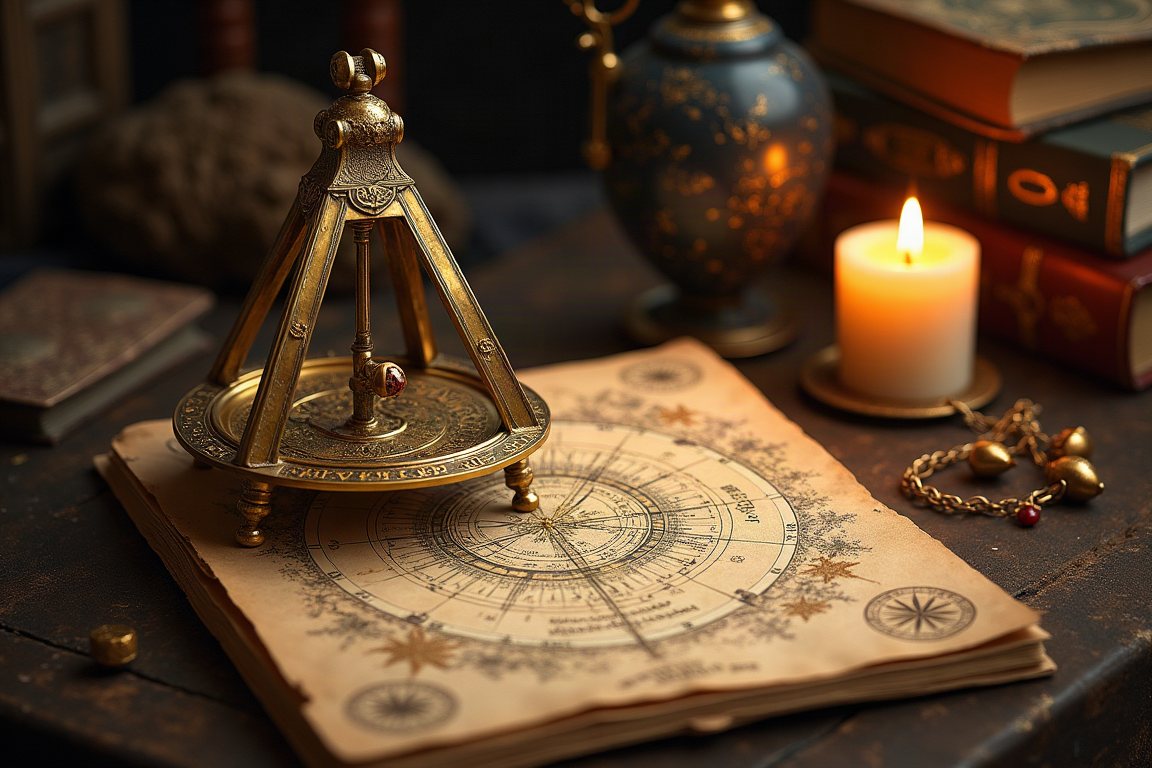
Strip the machinery to its parts. A natal chart is a snapshot of the sky from one place at one moment: the ecliptic — the sun's yearly road — divided into twelve signs; the planets placed along it; the whole wheel aligned to the local horizon and so cut into twelve houses, the stages of an ordinary life. The grammar of interpretation is a symbolic one, cousin to the symbolism of numbers and emblems: each planet a drive, each sign a style, each house a department of experience, each angular relation between planets — the aspects — a conversation, easy or tense.
A chart does not say what will happen. It offers a symbolic portrait — the sky's own mirror — and what a mirror does with you is your work.
An honest word before the practice
This library keeps a reading room, not a fortune-teller's booth, so the epistemics belong in the essay and not in a footnote. Controlled studies have not supported astrology's predictive claims; no mechanism for planetary influence on personality survives physics; and the honest history shows the tradition itself was always arguing about fatalism — the ancients' own maxim, the stars incline, they do not compel, was a fighting slogan, not a disclaimer. Two millennia of serious people kept the practice not because it forecast their futures but because it did something else, something the modern sciences of personality do not attempt: it gave experience a symbolic vocabulary. When astrology says Mars in the tenth house, it is doing what literature does when it says Othello — not measuring a person, but offering a lens so exact that you see yourself from a new angle. Lenses can flatter and lenses can distort. The wise user of any lens knows which one they are holding.
A reading practice: three questions, one season
If you want to work with your chart the way the reflective tradition intends — as a map of becoming rather than a verdict — try this. Have your chart cast by any of the standard tools, then put the encyclopedia away. Ask only three questions, over a whole season:
Where is the light? Find the Sun's sign and house. Not your "sign" as pop culture uses the word, but simply: what does the tradition say this position tends toward, expressed and unexpressed? Write one paragraph of honest self-assessment against it — where it lands true, where it misses. The misses matter most; a symbol that cannot miss is saying nothing.
Where is the friction? Find the hard aspects — the squares and oppositions, the tense planetary conversations. Every chart has them. Name one recurring difficulty in your life that the symbol genuinely resembles. You are not looking for fate. You are looking for a shape in which to hold something you already know.
Where is the becoming? Traditional astrology read the slow outer planets as generational weather and the fast ones as seasons of a life. Choose the coming twelve months and find, from any ephemeris, which houses the fast-moving lights will cross. Make no predictions. Instead set one intention per crossing — study for the ninth-house months, tending for the fourth — and let the sky be your planner's metaphor.
Done this way, the practice converges with journaling, with the examination of conscience, with every disciplined technology of self-knowledge the species has tried — and it adds the oldest advantage of all: you do the work under an open sky you can actually see, moving as it moved for the shepherds who first named it.
The map and the road
The stars have outlasted every empire that read them, and they will outlast ours. The question was never whether they compel us — they do not. The question a night sky asks is quieter: the same lights that timed the Nile floods are timing this evening, and you are invited to know where you are on the wheel. Maps of becoming do not walk for you. They only make it impossible to pretend you do not know the terrain.
Our Spirituality shelf holds the star-reading tradition alongside the paths of prayer and contemplation — the sky's map among the inner ones. For the planets put to work, The Sorcery of Solomon walks the 44 planetary pentacles of the Magician King.
Further reading
The encyclopedia's history of astrology carries the story from Babylonian omen tablets to the twentieth century without mystification; and the foundational Greek textbook — Ptolemy's Tetrabiblos, the four books that fixed the chart's grammar — is readable in J. M. Ashmand's 1822 English translation, complete on the Internet Archive.